

The Midterms Shook Wall Street. Should They Shake Your Portfolio?
Well, the midterm elections are behind us. The votes have been cast, the political analysts have weighed in, and Wall Street has wasted little time trying to figure out what it all means.
On Wednesday, investors celebrated with a powerful stock market rally following the Democrats’ victories in both the House and Senate. Why the enthusiasm? Wall Street initially welcomed the prospect of divided government, which could limit major policy changes. Falling oil prices and lower interest rates also helped fuel the optimism. The Dow surged more than 1,500 points.
By Thursday, however, investors were looking at the other side of the coin. Concerns emerged that a Democratic-controlled Congress could impose tighter regulations on artificial intelligence and potentially slow the construction of the massive data centers supporting the AI boom. That triggered heavy selling in semiconductor and technology stocks, which quickly spread to the broader market.
The S&P 500 plunged 4.4%, the Nasdaq dropped 5.5%, and the Dow lost more than 1,800 points. In fact, Thursday marked the Dow’s worst second trading day following a midterm election in records dating back to 1896.
Apparently, Wall Street’s post-election honeymoon lasted about 24 hours.
But here’s where a little perspective becomes valuable. Despite Thursday’s dramatic selloff, the S&P 500 was down approximately 2.8% over the two trading days combined. And even after all that turmoil, the index remained up roughly 7.4% for the year.
Two days of dramatic headlines. A modest net decline. And a stock market still solidly positive for 2026.
So, should investors be making major changes to their portfolios based on this week’s events? For most long-term investors, the answer is no.
The Market Doesn’t Vote Republican or Democrat
One of the biggest mistakes investors make is allowing their political preferences to influence their investment decisions. When their preferred party wins, some investors become overly optimistic. When it loses, others fear the worst. Either reaction can lead to costly decisions.
History tells a different story. The stock market has delivered positive long-term returns under both Republican and Democratic administrations. There have been bull markets, bear markets, recessions and recoveries under both parties. That’s because markets ultimately respond to much more than politics. Corporate earnings, economic growth, interest rates, inflation, innovation and consumer spending all play important roles.
Your political outlook and your investment outlook don’t have to be the same.
Market Declines Are Normal. Really Normal.
One of our favorite charts comes from J.P. Morgan Asset Management’s Guide to the Markets. It illustrates a simple but incredibly important lesson about investing.
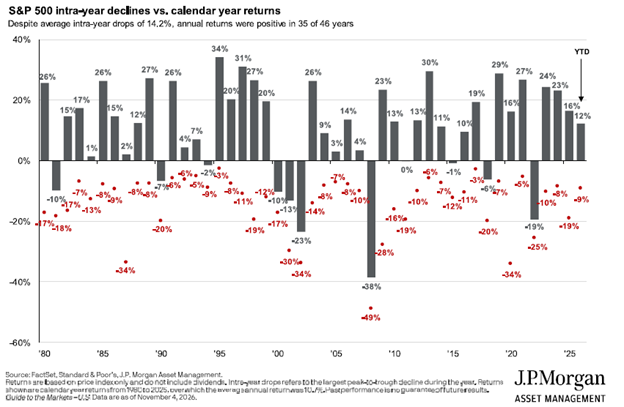
Over the 46-year period shown, the S&P 500 experienced an average intra-year decline of 14.2%. That’s right—even in years that ultimately delivered positive returns, investors frequently endured substantial declines along the way.
Yet despite those declines, the market finished the year with a positive return in 35 of those 46 years.
Think about that for a moment. The market doesn’t need to go up in a straight line to reward patient investors. In fact, it rarely does.
Unfortunately, market declines feel much worse when we’re experiencing them than they look when reviewing a historical chart. It’s easy to look back at a correction and say, “I would have stayed invested.” It’s considerably harder when financial television and other news sources predict the next catastrophe. And let’s face it, CNBC and TikTok isn’t exactly known for its calming influence.
Market Timing: You Have to Be Right Twice
When markets become volatile, the temptation to move into cash can be powerful. The logic sounds reasonable: sell now, wait for things to settle down, and reinvest when the outlook improves. Unfortunately, that strategy requires getting two decisions right.
First, you need to know when to get out. Second—and often more difficult—you need to know when to get back in.
Markets frequently recover before the economic or political outlook becomes clear. By the time investors feel comfortable returning, a substantial portion of the recovery may already have occurred. Remember the early days of COVID-19? As the pandemic unfolded, stocks plunged and many investors feared the worst. Yet the market bottomed on March 23, 2020, and began a remarkable recovery while much of the country was still shutting down. Investors who waited for the all-clear missed a significant portion of that rebound.
The goal isn’t to avoid every market decline. It’s to participate in the long-term growth that makes enduring those declines worthwhile.
Discipline Beats Predictions
At DWM, we don’t have a crystal ball, nor do we pretend to know exactly how markets will react to election results, what the Federal Reserve will do next, or which asset class will outperform over the coming months. Neither does anyone else, regardless of how confidently they appear on television or online.
Thursday’s selloff also provided a painful reminder about concentration risk. Semiconductor stocks were particularly hard hit, with the Philadelphia Semiconductor Index plunging 12%. Some of the biggest names suffered even steeper losses: Advanced Micro Devices (AMD) fell more than 17%, Micron Technology dropped over 17%, and Nvidia declined roughly 9%. It’s one thing to participate in a promising investment trend; it’s another to have too many of your eggs in the same basket.
That brings us to artificial intelligence. Many investors are understandably wondering whether AI represents the next great technological revolution, an investment bubble, or perhaps some combination of both. We believe AI has enormous long-term potential, but that doesn’t mean every AI-related stock is a good investment at today’s prices. Remember, the internet really did change the world, but plenty of investors lost money betting on the wrong companies during the dot-com boom. (For more on AI changing the world, see our recent blog.)
The good news is that we don’t have to predict whether AI is a boom or a bubble to manage portfolios successfully.
Our diversified equity investments provide exposure to companies benefiting from AI without making concentrated bets on a handful of technology stocks. We also maintain exposure across different sectors, company sizes and international markets, along with meaningful allocations to fixed income, real assets and alternative investments.
If AI continues to drive economic growth, our equity investments should participate. If AI-related stocks experience a significant correction, our diversification is intended to help cushion the impact.
Importantly, staying disciplined doesn’t mean doing nothing. We rebalance portfolios and make adjustments when appropriate, but those decisions are based on sound investment principles and changing circumstances—not fear, excitement or the latest headline.
This is where an experienced wealth management team like DWM can make a meaningful difference. Our job isn’t simply to manage investments. It’s to help clients maintain perspective, avoid costly emotional decisions and stay focused on what they’re ultimately trying to accomplish.
The Bottom Line
The election may change the political landscape, and markets will continue to react as investors digest the implications. There will undoubtedly be more volatility ahead. There always is.
But your retirement goals, financial plan and long-term investment horizon probably haven’t changed because of what happened in Washington this week. So before making a significant investment decision based on the latest headline, ask yourself one simple question:
Has something fundamentally changed about my financial plan, or am I simply reacting to the news?
At DWM, we believe successful investing isn’t about predicting the next market move. It’s about having a thoughtful plan, maintaining discipline and allowing time to work in your favor.
Elections come and go. Market headlines come and go. A sound investment strategy should be built to outlast both.
Brett M. Detterbeck, CFA, CFP®
Detterbeck Wealth Management