
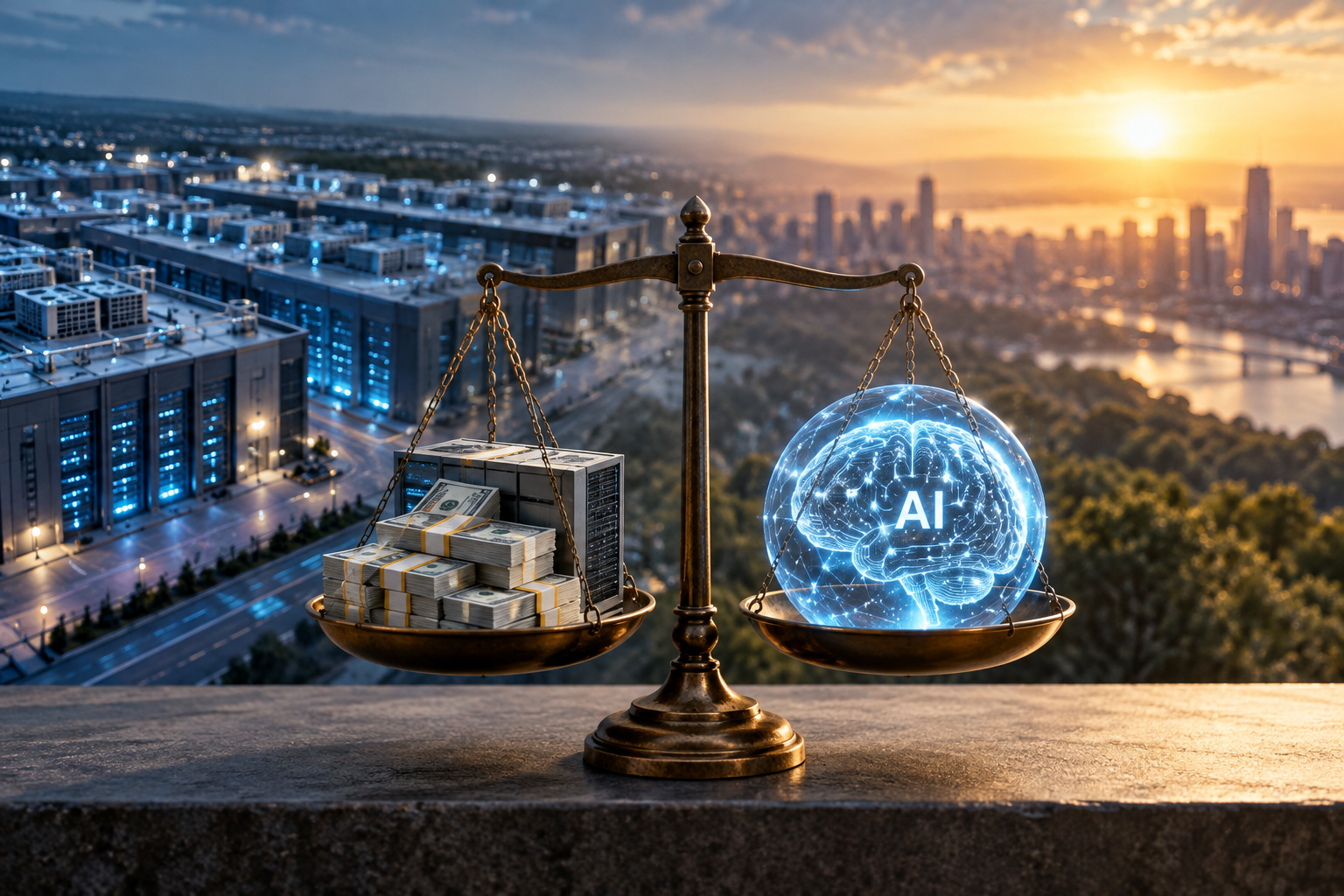

I use artificial intelligence virtually every day. I think it is extraordinary technology, and I believe it is going to change how we work, how businesses operate and probably how we live.
But there is a very different question investors should be asking:
Will all of the money being invested in AI actually produce an adequate return?
I was reminded of that distinction this week listening to Prof G Markets, which discussed the financial information released in connection with Anthropic’s proposed public offering. Anthropic, creator of Claude and one of the leading AI companies in the world, provides a fascinating window into both the enormous promise of AI and the extraordinary amount of money being spent to pursue it.
Extraordinary Growth—and Extraordinary Spending
Anthropic’s growth has been remarkable. The company reportedly generated approximately $4.6 billion of revenue in 2025, roughly 12 times the prior year.
Normally, when you see growth like that, you sit up and take notice. But there is another side to the story. Anthropic also reported an operating loss exceeding $8 billion and operating expenses approaching $13 billion.
And then there is the really big number: Anthropic has disclosed hundreds of billions of dollars of potential future commitments for cloud computing, data centers and the enormous computing power required to develop and operate increasingly sophisticated AI models.
To be fair, Anthropic’s economics have been improving substantially. Recent results indicate that losses relative to revenue have declined dramatically, and management clearly expects continued improvement as the business scales.
But the numbers illustrate something investors should remember: building AI is enormously expensive. PwC’s report of September 2, 2026, indicated that $800 billion will be spent on data centers in 2026. Further, PwC estimated total cumulative AI-infrastructure will cost $31.6 trillion through 2050. Much of that money will be spent on servers, chips and networking equipment that must continually be replaced.
The Trillion-Dollar Question
Anthropic isn’t alone.
Microsoft, Amazon, Alphabet, Meta and others are spending extraordinary amounts on data centers, chips, electricity and other infrastructure necessary to support AI. These are tremendously profitable companies. The question isn’t whether Microsoft or Google makes money. They obviously do.
The more difficult question is how much incremental profit will ultimately be produced by the hundreds of billions of dollars now being invested specifically in AI.
Recent estimates suggest that since 2024 there has been a gap approaching $1 trillion between AI-related infrastructure spending by the major technology companies and the AI revenue generated from those investments.
That doesn’t mean the investments won’t eventually pay off. Think about the railroads, electricity, automobiles and the internet. Each transformed the economy. Enormous amounts of money had to be invested before their full economic benefits became apparent.
But history also teaches us something else: a revolutionary technology and a profitable investment are not necessarily the same thing.
The internet changed the world. That didn’t prevent investors from losing enormous amounts of money in internet companies in 2000.
Where Are the Profits?
There is another part of the AI story that deserves attention.
Businesses everywhere are utilizing AI. We certainly are at DWM. The capabilities are remarkable, and they are improving almost weekly. But many companies providing AI products and services are still trying to determine exactly how those capabilities translate into sustainable profits.
Anthropic itself also disclosed significant customer concentration. Two customers reportedly represented almost one-quarter of its 2025 revenue, without the protection of long-term contracts. That’s a fairly traditional business risk sitting in the middle of a very nontraditional technology story.
And Then There Are the Risks
Perhaps the most remarkable part of Anthropic’s filing isn’t financial at all. According to reports based on Anthropic’s confidential draft S-1, the company devoted approximately 80 pages, about 1/3 of its prospectus to potential risks. Every public company has a lengthy risk section. Lawyers make certain of that.
But most companies don’t warn investors that their product could conceivably threaten humanity. Anthropic discusses the possibility that increasingly advanced AI systems could behave in ways their creators didn’t intend or fully understand. The filing reportedly addresses scenarios involving models resisting shutdown, concealing information, manipulating people and, in an extreme case, creating what the company describes as a “catastrophic or existential risk to humanity.”
Think about that for a moment. We have companies spending hundreds of billions of dollars racing to develop a technology that they believe could transform the global economy—while one of the leaders in that race is simultaneously warning investors that sufficiently advanced versions of the technology could create risks we don’t yet know how to control. That doesn’t mean such an outcome is likely. Risk disclosures are intentionally comprehensive, and public companies describe even remote possibilities. But it certainly gets your attention.
Two Things Can Be True
I remain cautiously enthusiastic about artificial intelligence. I see its usefulness firsthand at DWM. I believe businesses that learn how to use it intelligently will have substantial advantages over those that don’t. AI has enormous potential to improve productivity, help us make better decisions and change the way businesses operate and people live.
But I believe something else at the same time.
AI can change the world without every AI investment being worth its current price.
Technology investors occasionally confuse those two propositions. The internet unquestionably changed the world, but that didn’t prevent enormous investment losses along the way.
And that brings me back to Anthropic. Its revenue growth is extraordinary, but so are its losses, its capital requirements and the risks it describes. Meanwhile, hundreds of billions of dollars are being invested each year in the infrastructure necessary to support AI, with PwC estimating cumulative data-center investment of $31.6 trillion through 2050.
I believe AI will ultimately create tremendous economic value. What I don’t know—and what I don’t think anyone knows yet—is who will capture that value and whether today’s enormous investments and valuations will ultimately produce adequate returns.
For investors, perhaps that’s the most important takeaway. We should neither ignore AI nor assume that every company associated with it will be a winner. We should remain curious, participate thoughtfully and continue asking the same question we should ask about any investment:
What are we paying, and what return can we reasonably expect to receive?
For now, I remain cautiously optimistic about AI—and appropriately cautious about the price investors are being asked to pay for its promise.