


Looking Past the Headlines
If you relied solely on the headlines during the second quarter, you probably wouldn’t have guessed stock markets were headed for one of their strongest quarters in years.
The news suggested anything but optimism. Geopolitical tensions in the Middle East escalated following the Iran conflict. Oil prices surged. Inflation concerns resurfaced. Investors questioned whether the Federal Reserve would be able to lower interest rates—or perhaps even raise them. Yet beneath the daily headlines, markets quietly did what they have done throughout history: they looked ahead.
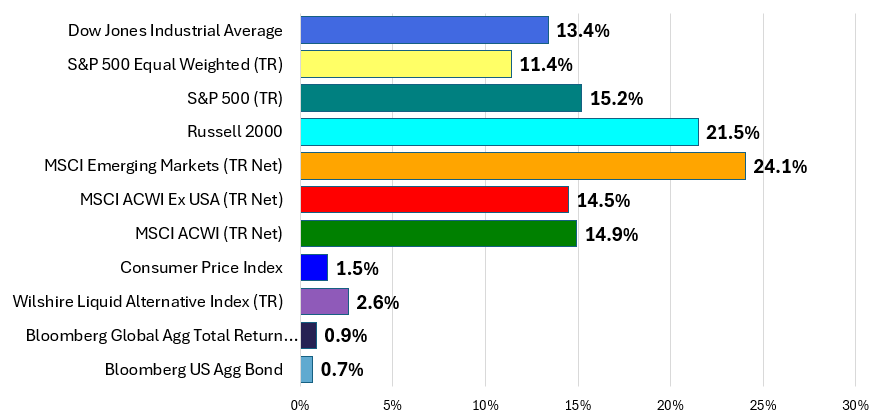
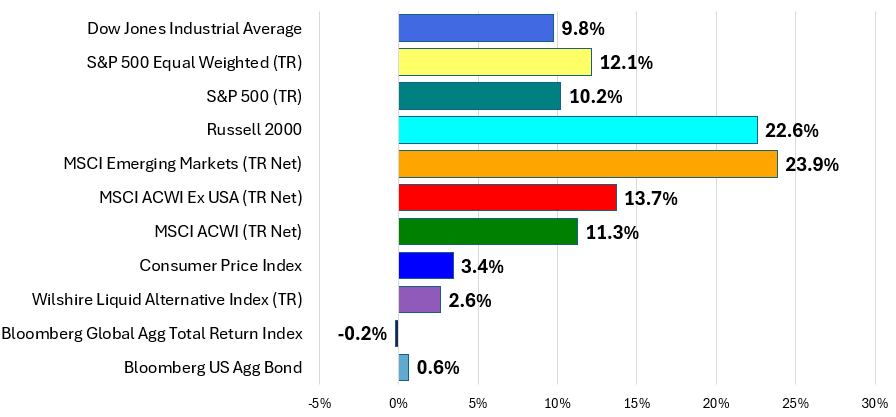
The results were remarkable. The S&P 500 gained 15.2% during the quarter, lifting its year-to-date return to 10.2%. International equities, as measured by the MSCI ACWI ex-U.S. Index, advanced 14.5% during the quarter and 13.7% year-to-date. Small-cap stocks were particularly impressive, with the Russell 2000 returning 21.5% for the quarter and 22.6% year-to-date. By quarter-end, major indexes had returned to record highs, reminding investors that markets often recover well before uncertainty fully subsides.
One thing the second quarter proved is that the stock market doesn’t watch the evening news; it watches the future.
For investors who stayed disciplined despite the daily barrage of unsettling news, the second quarter was another reminder that emotions and investment success often move in opposite directions.
Let’s take a look at the results for both the 2nd quarter of 2026 & for the First Half of 2026… (Spoiler alert: the headlines got this wrong.)
2Q 2026 RETURNS
FIRST HALF 2026 RETURNS
Equities: Looking Beyond the Noise
Equity markets delivered an impressive second quarter despite a steady stream of unsettling headlines. The S&P 500 gained 15.2% during the quarter and 10.2% year-to-date, while international stocks advanced 14.5% during the quarter and 13.7% year-to-date. Small-cap stocks led the way, with the Russell 2000 returning 21.5% for the quarter and 22.6% year-to-date.
When’s the last time you’ve gone a full day without hearing something “AI”?!? Well, artificial intelligence remained one of the market’s most powerful long-term investment themes, continuing to drive investment, innovation, and productivity expectations across the economy. At the same time, corporate America continued to execute. Approximately 85% of S&P 500 companies exceeded first-quarter earnings expectations – the highest percentage since 2021 – while profit margins remained near record highs.
Perhaps most encouraging, market leadership broadened as the quarter progressed. While AI-related investments continued to play an important role, gains increasingly spread across financials, industrials, healthcare, transportation companies, and smaller-cap stocks. That’s a healthy development. Markets tend to become more durable when leadership expands beyond a narrow group of companies, reinforcing one of our long-held beliefs that broad diversification – not concentrated bets – provides a stronger foundation for long-term investing.
Fixed Income: Holding Its Ground
Fixed income delivered modest positive returns during the second quarter despite continued uncertainty surrounding inflation and Federal Reserve policy. The Bloomberg U.S. Aggregate Bond Index gained 0.67% during the quarter and 0.62% year-to-date, while the Bloomberg Global Aggregate Bond Index returned 0.87% during the quarter but remained slightly negative (-0.21%) year-to-date.
At the beginning of the year, investors largely expected the Federal Reserve to begin lowering interest rates. The Iran conflict and the resulting spike in energy prices temporarily reignited inflation concerns, causing Treasury yields to move higher and prompting markets to reassess the path of monetary policy. Although oil prices eased significantly later in the quarter, inflation remains above the Fed’s long-term target, suggesting policymakers are likely to remain patient before considering additional rate cuts.
While fixed income didn’t produce eye-catching returns, it continued to fulfill its primary role within diversified portfolios by generating income, helping dampen overall portfolio volatility, and providing stability. Fixed income isn’t usually the life of the investment party, but it has a habit of showing up exactly when you need it.
Alternatives: Leadership Continues to Rotate
After carrying portfolios through much of 2025 and into the first quarter of 2026, gold—as represented by the iShares Gold Trust—declined approximately 14% during the second quarter. Even so, alternatives as a whole continued to contribute positively, with the Wilshire Liquid Alternative Index gaining 2.6% during the quarter and now up 2.6% year-to-date. Real Estate was a big winner within the alternatives category, up 10.1% in 2q26 and now 11.2% YTD, as evidenced by the Easterly Global Real Estate Fund.
Rather than viewing gold’s pullback as a setback, we see it as another reminder that leadership rotates. During the first quarter, alternatives helped cushion weakness in equities. During the second quarter, equities assumed the leadership role while a star alternative, aka gold, took a well-deserved breather.
Over a full market cycle, that’s precisely how diversified portfolios are designed to perform.
Putting It All Together
The first half of 2026 has been an excellent illustration of why diversification remains one of the few “free lunches” in investing.
The first quarter rewarded investors with exposure to alternatives, international markets, and value-oriented strategies. The second quarter rewarded investors with broad equity participation. Investors who maintained diversified portfolios—not only across asset classes, but also across investment styles, sectors, and geographies—were better positioned to benefit from both environments without needing to predict which asset class would lead next.
Diversification isn’t simply about reducing volatility. It’s about improving long-term outcomes by avoiding unnecessary concentration and allowing multiple return drivers to work together over a full market cycle. Frankly, trying to predict which asset class, investment style, sector, or security will outperform next quarter is a lot like trying to predict next week’s weather in Chicago—good luck!
Key Takeaway
Markets are forward-looking. While the headlines during the second quarter focused on war, inflation, and interest rates, investors remained focused on corporate earnings, innovation, and the long-term outlook. Successful investing isn’t about reacting to today’s headlines—it’s about maintaining a disciplined, diversified portfolio that is prepared for tomorrow’s opportunities.
What’s Next?
Looking ahead, there are reasons for both optimism and caution.
On the positive side, the fundamental backdrop remains encouraging. Corporate profit margins continue to hover near record highs, reflecting the resilience of American businesses. Perhaps most impressive, analysts expect S&P 500 companies to report 2Q26 earnings growth of 20%+! Further, the global economy has remained remarkably resilient despite geopolitical tensions, while artificial intelligence continues to drive innovation, productivity gains, and corporate investment across numerous industries. Encouragingly, market leadership has begun to broaden beyond a narrow group of technology-oriented companies, a positive sign for the sustainability of the current bull market.
At the same time, meaningful challenges remain. Stocks continue to trade at historically elevated valuations, leaving less room for disappointment. The latest year-over-year Consumer Price Index (CPI) reading came in above 4%, reminding investors that inflation has yet to fully return to the Federal Reserve’s long-term target. While energy prices have retreated significantly from their Iran-war highs, geopolitical risks remain elevated and could quickly alter investor sentiment.
History reminds us that markets don’t wait for uncertainty to disappear; they begin moving higher once investors can see beyond it. While the headlines will undoubtedly continue to evolve, maintaining a disciplined, long-term investment approach remains the most effective way to navigate whatever comes next.
Staying the Course
The second quarter was another reminder that successful investing isn’t about predicting the next headline; it’s about owning a thoughtfully diversified portfolio before the headlines arrive.
Markets will undoubtedly continue to present new challenges. Whether it’s geopolitical conflict, inflation concerns, central bank policy, or the next unforeseen event, uncertainty is simply the price investors pay for long-term returns.
The headlines will always be uncertain. A disciplined investment strategy shouldn’t be. At DWM, helping clients look past the headlines is one of the most valuable things we do.
Happy summer to all of you and good luck with those weather predictions!