


If 2026 has taught investors anything, it’s that markets rarely move in lockstep.
The first quarter was dominated by the war in Iran. The second quarter brought a powerful rebound in equities, fueled by strong corporate earnings and continued enthusiasm surrounding artificial intelligence. Then came the third quarter, when the Federal Reserve raised interest rates for the first time since 2023 and bond yields moved sharply higher.
The result? A little bit of everything.
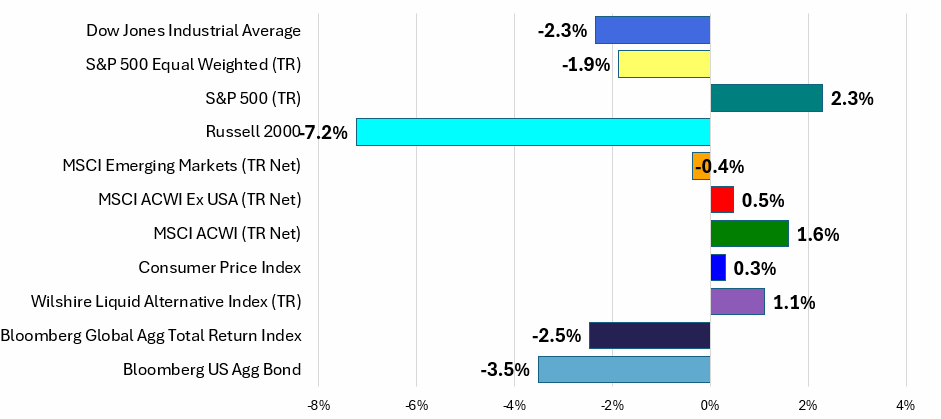
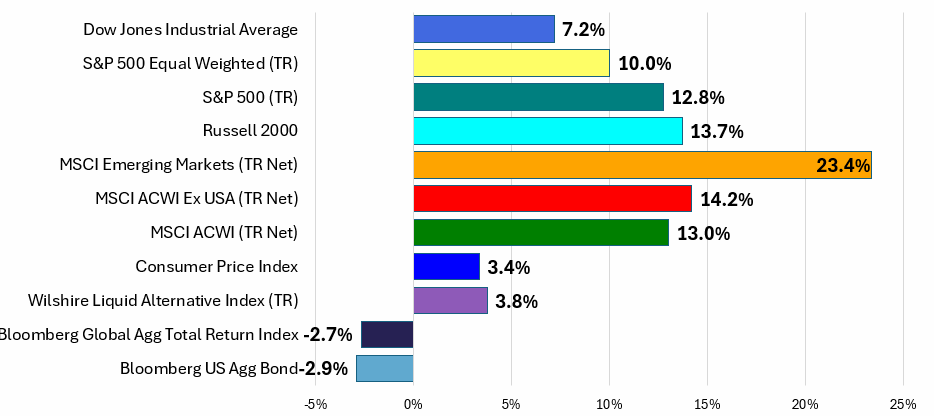
The S&P 500 gained 2.3% during the third quarter, bringing its year-to-date return to 12.8%. International equities barely budged during the quarter but remain up an impressive 14.2% for the year. Small-cap stocks fell 7.2% during the quarter, yet are still up 13.7% year-to-date. Meanwhile, bonds headed in the opposite direction, with the U.S. Aggregate Bond Index declining 3.5% during the quarter and 2.9% for the year. Alternatives continued to provide another source of positive returns.
One year. Three very different quarters. And very different investment results.
And that’s actually a good thing.
A properly diversified portfolio isn’t designed so that everything moves higher at the same time. Different investments are included precisely because they respond differently to changes in economic growth, inflation, interest rates and market sentiment. They are different by design.
Or, to put it another way: if every investment in your portfolio is doing exactly the same thing, you may not be as diversified as you think.
Let’s take a look at the results for both the third quarter and the first nine months of 2026.
3Q 2026 Returns
YTD 2026 Returns
Equities: Same Market, Very Different Results
At first glance, the third quarter appeared relatively uneventful for stocks. The S&P 500 gained 2.3%, while major indexes remained near record levels. Beneath the surface, however, results varied considerably.
Small-cap stocks declined 7.2%, as higher borrowing costs weighed more heavily on smaller companies. International equities were essentially flat for the quarter. Meanwhile, large U.S. companies continued to benefit from resilient corporate earnings and the enormous investment taking place around artificial intelligence.
Yes, AI has made another appearance in our quarterly commentary. At this point, we’d probably make news by not mentioning it. The AI investment cycle remains very real. Data centers, computing infrastructure and related technologies have become important sources of business investment and economic growth. But the investment benefits have also become increasingly concentrated. DWM recently explored this very issue in a recent blog, AI May Change the World. But Will It Make Money? The point is an important one: revolutionary technologies can create enormous economic value without every investment associated with them ultimately proving profitable. The internet certainly changed the world, but that didn’t prevent plenty of investors from losing money along the way.
That’s why valuation and diversification still matter, even when the technology really is revolutionary.
International diversification also continued to prove its worth. International equities are up 14.2% through September, slightly ahead of the S&P 500’s 12.8%. After years of U.S. market dominance, 2026 has provided a useful reminder that investment opportunities don’t stop at the U.S. border.
Fixed Income: Pain Today, Opportunity Tomorrow
Bond investors probably aren’t framing their 2026 statements and hanging them on the wall – at least, not yet.
The U.S. Aggregate Bond Index fell 3.5% during the third quarter and is down 2.9% year-to-date, while global bonds declined 2.5% during the quarter and 2.7% for the year.
The culprit is fairly straightforward: rising interest rates. The Federal Reserve raised rates in September, while longer-term Treasury yields moved sharply higher. Because bond prices move inversely to interest rates, existing bonds suffered.
But there is another side to the story: Higher rates also mean investors are finally being paid attractive yields for owning high-quality bonds. With yields near 5% at the front end of the yield curve, prospective returns have improved considerably. Should the economy eventually weaken, bonds could also provide valuable diversification if interest rates decline.
But there is another side to the story: Higher rates also mean investors are finally being paid attractive yields for owning high-quality bonds. With yields near 5% at the front end of the yield curve, prospective returns have improved considerably. Should the economy eventually weaken, bonds could also provide valuable diversification if interest rates decline.
In other words, the recent pain in bonds may be creating considerably better opportunities going forward.
Alternatives: More Than Just a Supporting Role
Alternatives have quietly been one of the better stories of 2026.
While the broad Wilshire Liquid Alternative Index gained 1.1% during the quarter and 3.8% year-to-date, several strategies utilized in many DWM portfolios have performed considerably better.
The BlackRock Systematic Multi-Strategy Fund (BDMIX), for example, gained 6.9% during the third quarter and is up 16.0% year-to-date, while the Standpoint Multi-Asset Fund (REMIX) gained 5.9% during the quarter and an impressive 18.4% year-to-date.
These strategies aren’t dependent solely on stocks rising or interest rates falling. That’s exactly what we want from alternatives: different sources of return that don’t necessarily travel in the same direction as traditional stocks and bonds.
Oil also deserves special attention. The Middle East conflict has kept energy prices and transportation costs elevated, contributing to inflation pressure and complicating the Federal Reserve’s job. Prices could decline if tensions ease, but depleted strategic reserves and continued geopolitical uncertainty may make a complete return to pre-conflict conditions more difficult.
Oil isn’t just another commodity right now. It’s influencing inflation, interest rates, consumer spending and ultimately Fed policy—making it one of the most important economic variables we’re watching.
Putting It All Together
Despite all the twists and turns, 2026 has been a successful year so far for most diversified investors.
That may be easy to overlook given the difficult year for bonds. But through the first nine months, U.S. large caps, small caps and international stocks have all posted double-digit gains, while alternatives have also contributed positively.
In other words, diversification has been doing its job. Successful investing doesn’t require predicting which asset class will lead next. Diversification allows us to own multiple sources of return before we know which one will outperform.
Key Takeaway: Different investments will lead at different times. That isn’t a flaw in a diversified portfolio; it’s the whole idea.
What’s Next?
As we enter the final quarter of 2026, the economic picture remains complicated.
The labor market is slowing, although perhaps not as dramatically as some headline employment numbers suggest. Changes in immigration policy and an aging population have also reduced growth in the available workforce, making the employment picture more nuanced than the headline numbers might suggest. Meanwhile, wage growth has struggled to keep pace with inflation, continuing to put pressure on consumers.
Economic growth, however, has remained surprisingly resilient, helped in part by significant investment in AI and related infrastructure.
The Federal Reserve now finds itself balancing those competing forces. Markets may actually be expecting a more aggressive Fed than policymakers ultimately deliver. If inflation meaningfully moderates in 2027, the Fed may have room to remain on hold following another potential rate increase in December.
Federal deficits remain another concern. Rising Social Security and Medicaid expenditures, combined with large government borrowing needs, could keep upward pressure on longer-term interest rates even if inflation eventually improves.
And then there’s oil. A meaningful decline in energy prices could help inflation, consumers and the Fed simultaneously. Another geopolitical flare-up could do exactly the opposite.
So yes, there are still plenty of things to worry about. That said, for investors, there always are. That’s where DWM can help— separating the important signals from the daily noise, adjusting portfolios when appropriate, and helping our clients stay focused on the long term.
Staying the Course
Markets rarely move together, and 2026 has been a particularly vivid reminder.
Different investments have taken turns leading and lagging throughout the year. Some of today’s least popular investments may ultimately become tomorrow’s opportunities, while today’s market darlings won’t remain on top forever.
That’s investing. The goal isn’t to predict every turn. It’s to build a portfolio capable of navigating them.
At DWM, we don’t know exactly which investment will lead next quarter—and neither does anyone else. That’s why we build portfolios with multiple sources of return, thoughtfully rebalance them, and maintain a long-term perspective rather than chasing whichever investment happens to be winning today. After all, chasing an investment after everyone already loves it is usually a pretty expensive way to join the party.
Our portfolios are different by design. And in a year like 2026, we’re reminded why.
Brett M. Detterbeck, CFA, CFP®
DETTERBECK WEALTH MANAGEMENT