
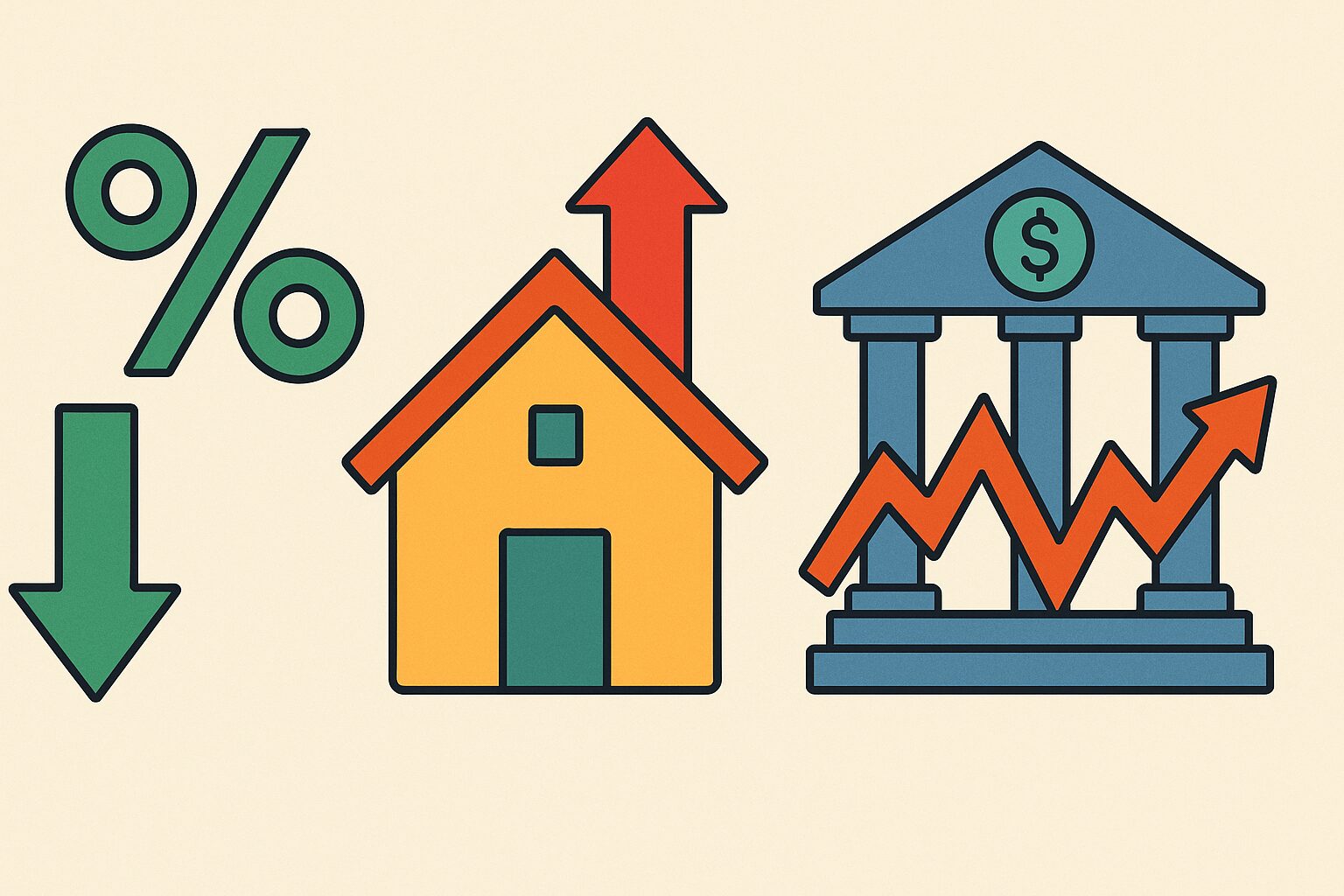

Recently, we’ve had a few clients ask us if it’s the right time to buy a home. It’s a fair question, and one that doesn’t have a single answer. Mortgage rates, home prices, and the broader economy are all pulling in different directions, creating uncertainty for buyers who just want to make the “correct” decision. The truth is that several factors are at play, and understanding each one helps clarify whether now or later is the answer for a potential buyer.
Mortgage Rates and Affordability
Rates are the headline story right now. After spending most of 2020 and 2021 near 3%, mortgage rates have hovered closer to 7% for much of this year. That shift alone has reshaped affordability. A one percent change in mortgage rate can alter the payment on a $400,000 loan by roughly $300 a month.
It’s natural to want to wait for rates to fall, and they likely will as inflation cools and the Fed loosens monetary policy. However, markets don’t move in straight lines. It can take one bad inflation reading to change the entire story. Forecasts are rarely unanimous, and while rates could trend lower, no one can predict the exact timing. Meanwhile, many buyers are playing the “rate game,” waiting for that perfect number while home prices in their areas continue to climb. Refinancing later is always possible, but lost appreciation is not. The better question might be whether the current payment fits comfortably within your budget today.
It’s also worth noting that supply and affordability look different depending on where you live. In some parts of the country, prices have leveled off and competition has cooled down. In others, especially in markets with strong job growth and limited supply, homes are still selling quickly and often above the list price. Costs can vary significantly depending on where you live.
Housing Supply and Price Pressures
The next factor is supply, or the lack thereof. Many homeowners are “locked in” with sub-4% mortgages and have little incentive to sell. This causes a housing market with fewer listings than at any point in the past decade.
For buyers, that means higher competition for fewer homes. The good news is that price growth has slowed from the double-digit surges of 2021 and 2022. But don’t expect broad declines unless something changes in inventory. If rates drop next year, pent-up demand from the “rate game” players could quickly erase any small price corrections we’ve seen.
Construction Costs and New Home Availability
It’s a reasonable assumption that more new homes could solve the supply issue, but it’s a lot easier said than done. Builders have struggled for years with labor shortages, expensive materials, and stricter zoning requirements. These factors have pushed construction costs well above pre-pandemic levels.
Even if the price of critical materials drops, the cost of labor and land remains stubbornly high. Builders are doing what they can to entice buyers, offering temporary rate buydowns or closing-cost credits, but they’re often working with thin margins. The result is that most new builds fall into higher price brackets, leaving entry-level buyers competing for the same limited pool of existing homes.
Until the pace of new construction begins to exceed the rate of household growth, we’re likely to stay in this environment of tight supply and solid pricing. That doesn’t mean buyers should rush, but it does mean waiting for a construction-driven price correction could take longer than most expect.
Economic Uncertainty and Job Stability
Of course, none of this exists in a vacuum. The broader economy, including inflation, job security, and market volatility, plays a big role in whether it is the right time to commit to a mortgage payment.
When rates eventually come down, it will likely be because the economy is slowing and the Fed is trying to stimulate growth. That can help with affordability, but it may also bring uncertainty to income and employment. A lower monthly payment doesn’t mean much if you lose the source of income to cover it.
That’s why one of the most important questions to ask isn’t “what will rates do next year,” but “how confident am I in my income over the next five?” If your career, savings, and cash flow are in a stable place, then you’re in a stronger position to buy even in an uncertain economy.
Personal and Lifestyle Considerations
Beyond the economics, this decision often comes down to personal timing. Like we often say to our clients, the numbers are only one part of the decision. There can be real value in the sense of stability, comfort, and pride that comes with owning a home. The psychological benefit can matter just as much as the financial one, especially if the home fits your lifestyle and long-term goals.
I’m asking myself the same questions. Personally, I’m looking to buy within the next couple of years. The numbers make sense, and I could afford it comfortably, but I’m waiting for better timing with my apartment lease and, more importantly, until I find a home I love. It’s a reminder that financial readiness and emotional readiness don’t always line up at the same time.
If you can answer yes to those key questions, it might make sense to move forward even in a higher-rate environment. If not, renting a bit longer can provide flexibility without pressure. The right time is rarely when the market is perfect. It is when you’re ready.
The Bottom Line
Trying to time the housing market is a lot like trying to time the stock market: it’s rarely a winning strategy. Rates, prices, and supply all move in complex ways, and they rarely align perfectly. Instead of waiting for the stars to align, focus on what you can control—your financial readiness.
If the numbers make sense, your cash flow is strong, and the home fits your lifestyle, there’s no need to wait for a lower rate that may come with a higher price tag. On the other hand, taking the time to strengthen your financial foundation is never a bad decision. If you’re questioning if a home purchase makes sense in your financial plan, we can give you the answer. If you’re questioning if a purchase makes sense with your lifestyle and goals, we’re here to talk you through that and we can find the answer together. Give us a call, send us an email, or stop by the office and we’ll take a holistic approach to find the right answer for you.
At DWM, our view is simple: buying a home should be a long-term decision made within the context of your full financial plan. The best time to buy isn’t when rates fall or headlines shift. It’s when the purchase fits comfortably and confidently into the bigger picture of your life.