
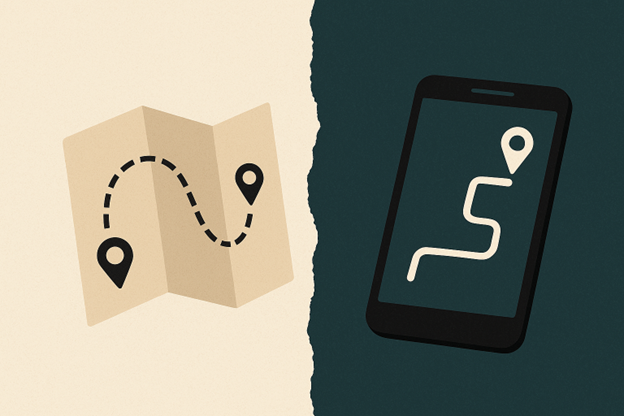

As most of the people reading this blog have experienced first-hand, GPS absolutely revolutionized the way we travel. Well, it didn’t materially change the way that we travel. It also didn’t get us to our destination faster. Maybe it didn’t really revolutionize travel at all- it just changed who was doing the thinking. It made the process easier by removing the need to plan routes in advance, memorize directions, or pay close attention to our surroundings. There’s no argument that the invention and broad implementation of GPS was a net positive for society. By transferring the process of thinking to a device, we allowed ourselves to focus on other, more important things. Instead of devoting our focus to navigation, we freed up our thoughts to plan the day, brainstorm that difficult problem at work, or lose ourselves in a podcast.
Efficiency is valuable, but it’s not without a cost. Over time, GPS has quietly eroded our ability to navigate without help, leaving us far more dependent on technology than we realize. A 2020 study in Scientific Reports found that frequent GPS users experience measurable declines in spatial memory over time, including a reduced ability to form mental maps and remember key landmarks. This is not an isolated phenomenon. With each new technology that has become mainstream, we delegate another small piece of our thinking to machines. Slowly, but surely, this reshapes the way we interact with the world and sometimes even how our brains themselves function.
The danger is a gradual one. Of course, this dependency can lead to incompetence if these technologies fail us, but the concern we’re focusing on today is not contingent on the future availability of these technologies, but rather the mental decline that is a result of these dependencies. Humanity will only move forward technologically. As we remove more and more of these critical thought processes, our brains adapt by trimming away the skills we no longer use. What once was a strength, such as remembering directions, phone numbers, or even how to solve basic math problems in our heads, becomes a dormant skill. And once those abilities lie dormant long enough, reviving them is far more difficult than handing them off to a device in the first place.
Therefore, we have compiled a list of those skills that are slowly being degraded that we think are most critical. To combat the decline, below are good practices to stay sharp and maintain these skills in the age of AI.
1. Navigation & Spatial Awareness
• Decline: With GPS handling nearly every trip, we’ve lost the habit of forming mental maps or noticing details along the way.
• Practice: Try to only use GPS once for a new location. Pay attention while driving so you no longer have to rely on it for repeat trips. Occasionally print out directions ahead of time and navigate the old-fashioned way to stay sharp.
2. Memory Recall
• Decline: Phones store our contacts, lists, and birthdays, so we rarely need to hold this information in our own minds.
• Practice: Memorize phone numbers, addresses, or short lists without saving them digitally. Training your brain to recall these details keeps memory active.
3. Mental Math & Estimation
• Decline: Calculators and apps have made us quick to outsource even simple arithmetic, leaving many people uncomfortable with numbers.
• Practice: Do quick math in your head for tips, time estimates, or budgeting. For more complex multiplication and division, practice working it out on paper instead of reaching for a calculator.
4. Critical Thinking & Problem-Solving
• Decline: AI and instant search give fast answers, but they short-circuit the process of wrestling with a question, weighing options, or building deeper understanding.
• Practice: If you rely on AI for answers, try using Google more often – and even better, reference original sources through books, journals, and articles. Slowing down forces you to think critically about the information.
5. Vocabulary & Language Skills
• Decline: Autocorrect, predictive text, and quick content blurbs reduce the need to use precise words or read complex sentences. Over time, vocabulary and clarity can shrink.
• Practice: Read more long-form writing such as books, essays, or thoughtful journalism. Immersing yourself in richer language strengthens comprehension and sharpens communication.
6. Creativity & Imagination
• Decline: With endless videos, feeds, and even AI-generated content at our fingertips, we spend more time consuming ideas than creating our own.
• Practice: Instead of scrolling, carve out time to make something yourself – sketch, journal, or brainstorm solutions without prompts. This strengthens imagination and keeps your thinking original.
We tell our kids, “That phone is making you stupid.” But the truth is, the same applies to us as adults. In many ways, we’ve already become cyborgs. We operate hand-in-hand with technology in nearly every aspect of daily life. This partnership makes us faster, more efficient, and often more productive, but it also comes at a cost. Each time we outsource a skill, we risk letting it decline. The goal is not to abandon technology; that would be unrealistic. Instead, we should use it with intention. By deliberately exercising the mental muscles that convenience tends to weaken, we protect our independence, sharpen our thinking, and ensure that efficiency doesn’t come at the expense of capability.