

A rising tide lifts all boats” is a familiar phrase in the financial world, often used to describe broad shifts in market sentiment that influence returns. While catchy, it doesn’t explain the forces behind these movements. What truly shapes market perception? Intriguingly, some analysts suggest the answer may be the same as what affects the tides, the moon.
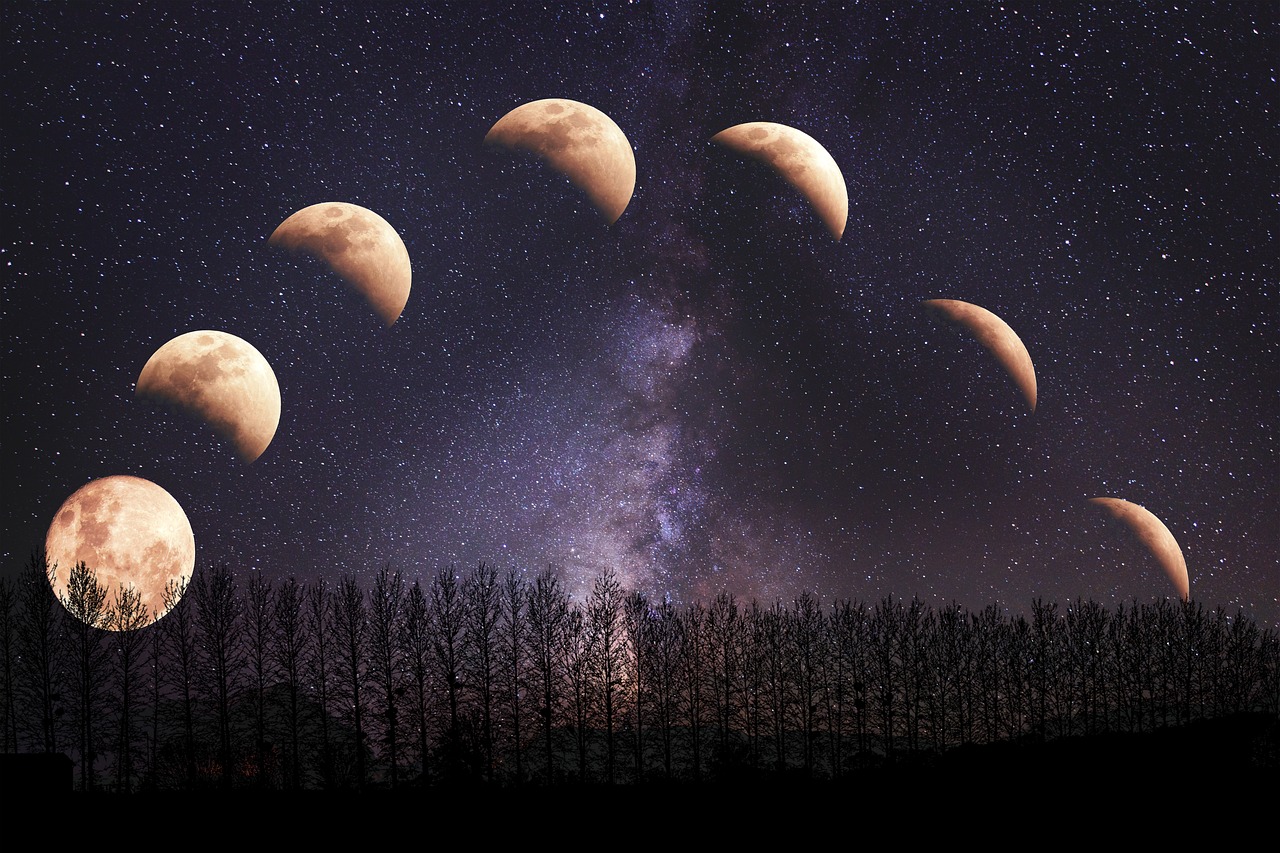
Just as our bodies respond to the sun, staying awake when it rises and sleeping when it sets, our moods and emotions can also be influenced by lunar phases. Historically, bright full moons were associated with poor sleep, irritability, and irrational behavior, while dark nights during new moons encouraged deep sleep and a more optimistic outlook. Modern life allows us to control our light exposure with TVs, phones, and artificial lighting, but it may not fully erase these deep-rooted emotional patterns. Below, the moon cycle images illustrate the new moon (on the left) which resulted in dark, restful nights, while the bright full moon (on the right) would have made it difficult for our ancestors to get much-needed sleep.
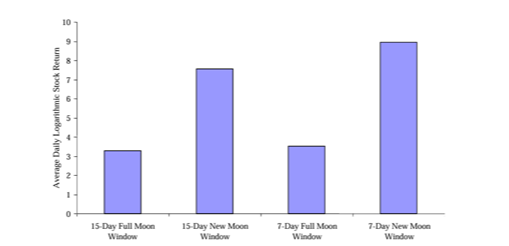
The 2006 study “Are Investors Moonstruck? Lunar Phases and Stock Returns” by Kathy Yuan, Lu Zheng, and Qiaoqiao Zhu explored whether full and new moons affect stock market returns globally. Analyzing data from 48 countries, the researchers found that returns tended to be lower around full moons and higher around new moons, with an annual difference of roughly 3–5%. The study accounted for other factors such as daily price swings (volatility), trading volume, and major macroeconomic announcements, and the lunar effect persisted. The authors propose that these patterns may be linked to human psychology: investor mood appears to fluctuate with the lunar cycle, subtly influencing buying and selling decisions. These findings challenge traditional financial theories that assume investors always act rationally, showing that even natural rhythms like the moon’s phases can leave a measurable imprint on markets. The chart below illustrates how an investor focusing on the full moon might experience different returns over time compared to one investing during new moons.
Further research followed in 2013 with “Moon Phases, Mood and Stock Market Returns: International Evidence” by Christos Floros and Yong Tan. This study analyzed 59 international markets using a threshold generalized autoregressive conditional heteroscedasticity (TGARCH) model and found that lunar phases affected stock returns in various markets. Specifically, new moons positively influenced returns in the UK, Switzerland, Bangladesh, Chile, and Cyprus, while full moons had a negative effect in Jordan. The study also found interactions with other calendar anomalies, such as the Monday and January effects, particularly in emerging markets. Lunar effects were generally stronger outside the Americas. These findings suggest that investor mood, influenced by lunar cycles, may contribute to calendar-related patterns in stock returns.
While these studies are intriguing and make for fascinating reading, the real value lies in understanding how this knowledge affects your own investing behavior. The key takeaway is that we are not entirely removed from our natural instincts, and those instincts often influence the way we handle money. Watching a portfolio plummet can be a gut-wrenching experience. It’s a feeling that tightens your chest, makes your stomach churn, and triggers an almost primal urge to sell immediately to “stop the bleeding.” On the flip side, seeing the market soar can make even the most disciplined investor feel tempted to jump in, fearing they’ll miss out on the next big gain. These emotional reactions are exactly what studies like Yuan, Zheng, and Zhu (2006) and Floros and Tan (2013) highlight, the subtle ways mood and behavior, even influenced by something as distant as the moon, can shape investment decisions.
This emotional tug-of-war helps explain why many individual investors struggle to outperform the market. A 2024 DALBAR study reveals that over a 20-year period, the average equity investor earned only 5.5% annually on their personal portfolios, compared to the S&P 500’s 9.9%. This underperformance isn’t due to a lack of intelligence or effort; it stems from poor timing decisions, the compulsion to react emotionally to market swings, and the cumulative effect of transaction costs. Every panic sale during a downturn and every impulsive buy at a market high chips away at potential long-term gains. These behaviors make it painfully clear why trying to time the market on your own is a risky endeavor.
That’s why having a sound investment advisor like DWM is so crucial, especially during times of high volatility. An experienced advisor brings perspective, discipline, and a carefully designed strategy tailored to your unique goals and risk tolerance. They can help you maintain a rational approach when the market is swinging wildly, ensuring that emotional impulses don’t dictate your financial future. A well-structured strategy incorporates long-term planning, tax efficiency, asset allocation, and portfolio rebalancing; considering everything from retirement needs to college savings to caring for loved ones. The goal is simple: keep your portfolio on course even when fear and excitement threaten to pull you off track.
At DWM, for example, we guide clients through a 3-5 session “boot camp” designed to lay the groundwork for disciplined, personalized investing. We work through risk tolerance assessments, goal setting, and real-life scenarios to build a strategy that anticipates emotional highs and lows. By understanding both your financial landscape and your behavioral tendencies, we help clients navigate the inevitable ups and downs with confidence. If the moon, nearly 250,000 miles away, can subtly influence our emotions and behavior, it’s easy to see how even larger, more immediate forces like political events, breaking news, or well-meaning advice from friends can sway investment decisions. A strong, thoughtfully constructed investment strategy acts as your steady ship, keeping you afloat while the emotional tides rise and fall.