
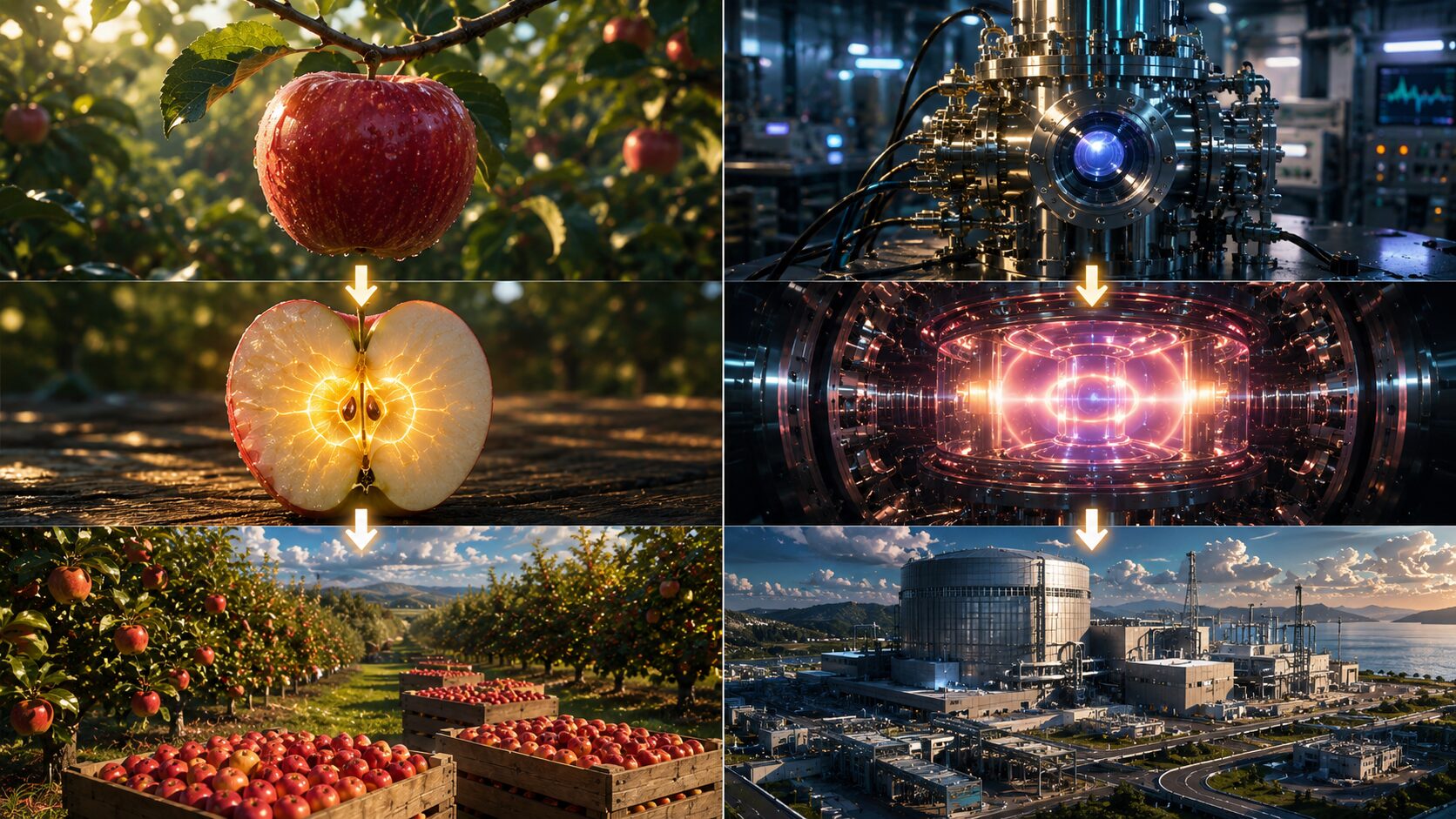

At a recent meeting, a client asked our team, “What do you think about nuclear fusion? Is there an investment opportunity there?” It was a great question, so we decided to take a closer look. For decades, fusion energy has been described as the ultimate energy dream: clean, abundant, reliable power with no carbon emissions and far less long-lived radioactive waste than traditional nuclear fission. The joke, of course, has always been that fusion is “30 years away and always will be.” That joke is starting to feel a little less certain.
There have been real scientific breakthroughs, major private investment, high-profile commercial agreements, and more government support than the industry has seen in decades. But from an investment perspective, the key question is not whether fusion is exciting. It is whether investors can reasonably expect to benefit from it in a timeframe that matters. The answer is: maybe, but probably not in the simple way people imagine.
What Fusion Actually Is
Fusion is the process that powers the sun and stars. Instead of splitting atoms apart, like traditional nuclear fission, fusion combines light atoms together and releases energy. If that process could be recreated here on Earth in a controlled and cost-effective way, it could eventually provide a massive source of reliable power. That is why the technology is so exciting. It is not just another clean energy idea – if we can make it work commercially, it could revolutionize the energy industry.
However, the important word is commercially. Creating fusion is not the same thing as creating a business that can sell fusion power at a profit. That distinction is where most of the investment conversation should begin.
The Milestones So Far
The first big milestone was proving that humans could create fusion at all. That happened in 1934, when Ernest Rutherford, Mark Oliphant, and Paul Harteck demonstrated fusion in a lab using deuterium, a heavier form of hydrogen. To simplify, we can compare the fission reaction to an apple. At that point, we proved we could “grow” or create an apple. That was an enormous scientific achievement, but it did not mean we had solved hunger or created a profitable apple farm. If someone burns 500 calories to grow an apple that contains 100 calories, the apple is still real and valuable, but the process does not yet make practical sense. That was fusion for a long time: proof of concept, not a power plant.
The next meaningful benchmarks came from controlled fusion experiments that started to look more like the kind of process that could eventually matter for power production. On November 9, 1991, the Joint European Torus, or JET, carried out the first deuterium-tritium experiment and produced fusion power from that fuel mix. Then in 1997, JET produced 16 megawatts of peak fusion power, a major step forward at the time. In apple terms, we had moved beyond simply proving an apple could be grown. We were learning how to grow better apples, in a more controlled setting, using a process that might someday resemble a real production system. But we still had not proven that the farm worked.
The breakthrough that really changed public perception came on December 5, 2022, at the National Ignition Facility at Lawrence Livermore National Laboratory. In that experiment, researchers achieved fusion ignition, meaning the reaction produced more fusion energy than the laser energy delivered directly to the target. Going back to the apple analogy, this is the moment where the apple finally contained more calories than the direct effort used to grow that specific apple. That is a real breakthrough, but this is also where headlines can get ahead of reality. The experiment produced more energy than the laser energy delivered to the target, not more energy than the entire facility consumed. In other words, the apple beat the farmer’s direct effort, but it still did not cover the cost of running the whole farm.
Since then, the results have continued to improve. Lawrence Livermore reported that an April 2025 experiment produced 8.6 megajoules of fusion energy from 2.08 megajoules of laser energy delivered to the target, which was a target gain greater than four. That means the apples are getting better, the farmer is becoming more efficient, and the science is clearly advancing. This is why the old joke about fusion always being 30 years away feels less certain than it used to. We are not talking about a vague concept anymore. We are talking about repeated experiments producing better results.
Where We Stand Today
Where we stand currently is somewhere between scientific breakthrough and commercial power plant. Fusion has not yet proven that the entire system can produce net useful energy after accounting for all energy inputs, equipment, maintenance, materials, fuel supply, downtime, regulation, financing, and grid connection.
That is the next major hurdle. It is not enough to grow an impressive apple. It is not even enough for the apple to beat the direct calories spent growing it. The whole farm has to work.
The Investment Reality
Private money is clearly paying attention. The Fusion Industry Association reported that fusion companies raised $2.64 billion in private and public funding in the 12 months leading to July 2025, bringing total funding for the surveyed fusion companies to about $9.766 billion. There are also early commercial signals, including Helion’s announced power purchase agreement with Microsoft for a planned fusion plant expected in 2028.
Those are meaningful developments, but they do not change the basic investment question. A signed agreement is not the same thing as delivered electricity, and funding is not the same as profitability. Fusion still has a long road ahead until it can breakthrough to business model.
Final Takeaway Fusion is worth watching closely, but it is not yet something most investors should rely on. Unfortunately, until someone proves that the full “apple farm” can operate reliably, sell energy at a competitive price, and generate consistent cash flow, fusion should be viewed as a fascinating underdeveloped technology, not the next great investment opportunity. In the meantime, a diversified portfolio is still the most sensible way to participate indirectly, since many of the companies funding, supporting, or eventually benefiting from fusion are represented in the major stock and corporate bond indexes.