


Few topics spark as much debate today as whether artificial intelligence is driving a true economic transformation or inflating the next market bubble. Valuations have surged, investment in data centers and compute power is exploding, and companies are racing to secure the infrastructure needed to support AI. And yet, AI is also generating real profits and productivity gains—unlike many past tech manias.
So, is this an AI bubble? Or simply the early stage of a long-term technological shift?
Below is a balanced look at the key arguments on both sides, followed by how DWM is guiding clients through this environment with discipline, diversification, and emotional support.
Arguments for an AI Bubble
1. Massive Valuations with Limited Earnings Impact
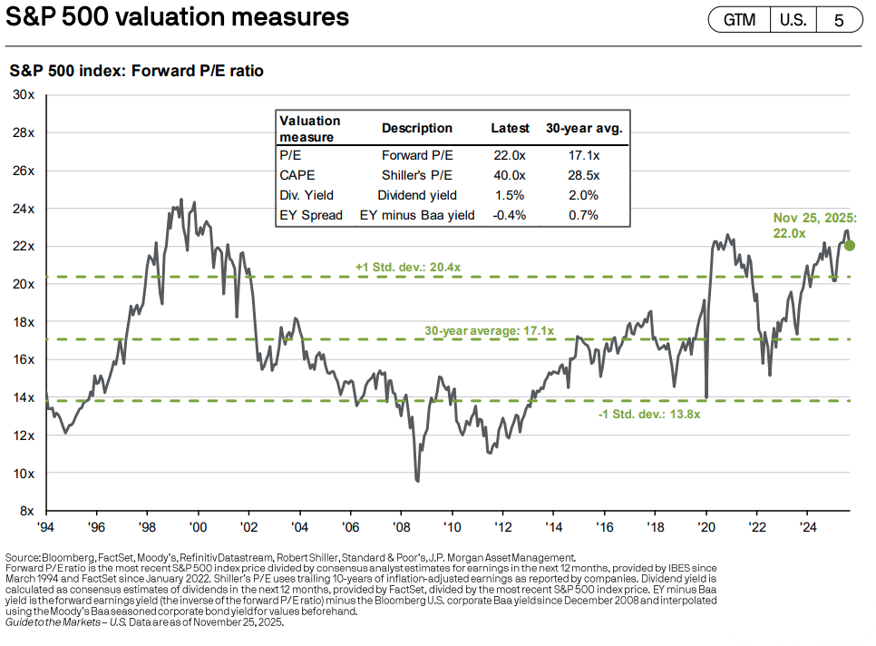
A major concern is how expensive many AI-exposed companies have become. Nvidia, Microsoft, Amazon, and Alphabet trade well above long-term valuation averages, with forward P/Es implying very high expectations for future earnings growth. Forward PEs for the S&P500 as a whole are near all-time highs, basically the highest its ever been besides right before the dot.com bust in the early 2000s per graph below. While profitable, much of the recent appreciation in these AI stocks reflects anticipated AI-driven revenue that has yet to broadly materialize.
2. Circular Demand and “Loopification”
Much of today’s AI spending is happening inside a tight circle. Companies like Microsoft, Amazon, and Google buy enormous amounts of chips from Nvidia. Nvidia then relies on those same tech giants to run the AI models built by startups such as OpenAI—many of which are also funded or heavily supported by Microsoft, Amazon, or Google. When the money keeps circulating within the same group of companies, it becomes difficult to know whether true customer demand exists outside that loop.
3. Aggressive Accounting Masks True Costs
Michael Burry (of The Big Short) has warned that tech companies may be boosting reported earnings by extending the depreciable life of AI chips from three years to five or six. This accounting shift can understate the massive capital expenditures required for GPUs and data centers.
4. Excessive Market Concentration
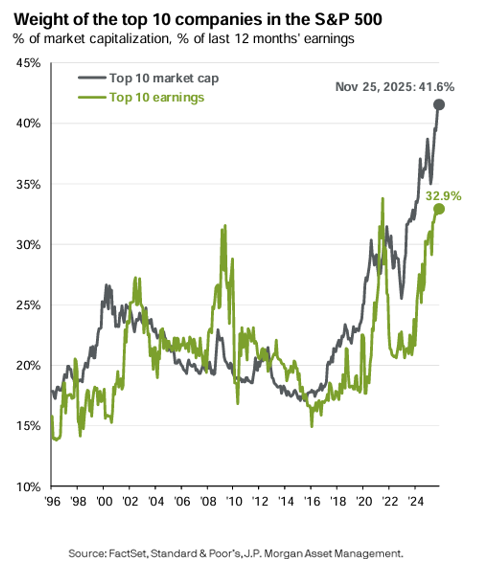
A small group of companies—particularly Nvidia—drives a disproportionate share of market returns. When leadership narrows this much, fragility increases. A single earnings miss can ripple across the broader market. One can see how concentrated the S&P 500 has become by looking at this chart below.
5. Enormous, Potentially Overbuilt Infrastructure
AI investment now rivals major industrial buildouts. For example, Microsoft’s agreement to help restart the Three Mile Island nuclear plant—idle since 2019—will help power future data centers. If demand falls short, such fixed investments could become overcapacity risks.
6. Global Warnings from Financial Leaders
Given all of above, its not surprising to hear calls from the Bank of England, the head of the IMF, and JPMorgan CEO Jamie Dimon all warning about the potential for a sharp correction, with some estimating a 20% decline.
Arguments Against an AI Bubble
1. Real Cash Flows and Profits
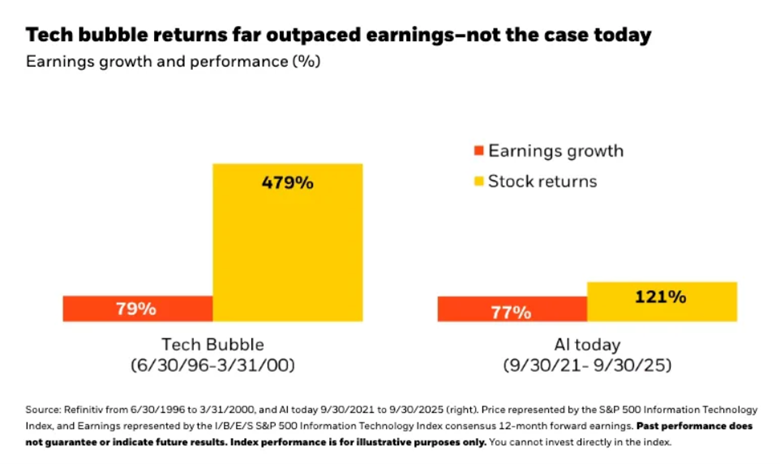
We’ve heard a lot of people compare current times to the Tech Bubble of the late 90’s. Very different – back then, the market was littered with a bunch of internet companies with negative earnings. Today’s AI leaders generate substantial earnings and huge profits! Nvidia’s profitability is significant, and companies like Microsoft, Alphabet, and Amazon are funding AI initiatives with real cash flow—not debt.
2. Investor Sentiment Is Not Euphoric
In contrast to the late-1990s tech boom, today’s bullishness (according to the American Association of Individual Investors) sits near long-term averages. There is enthusiasm, but not the widespread euphoria typical of bubbles.
3. Sustainable, Cash-Rich Financing
AI is being funded by some of the most cash-rich firms in the world, not by excessive leverage or speculative borrowing.
4. A Profound, Transformational Technology
AI is widely seen as foundational. Alphabet CEO Sundar Pichai has called it “the most profound technology humanity has ever worked on,” with potential impact greater than cloud or mobile.
5. Productivity Improvements Across the Economy
AI already drives measurable gains. Hospitals use AI to speed imaging analysis and reduce administrative burden. Banks rely on it for fraud detection and risk modeling. Manufacturers use AI for predictive maintenance and quality control. Retailers apply it to personalization and automation. These real-world examples demonstrate tangible value beyond hype.
6. Corrections Don’t Equal Collapse
Even if AI-heavy stocks pull back, corrections often prove “V-shaped”—sharp down, sharp up. A reset wouldn’t necessarily derail the broader AI trend.
Pullbacks Are Normal — and Timing Them Is a Fool’s Game
Even if we see a pullback, that’s not only normal—it’s healthy. Markets can’t rise in a straight line forever, and temporary declines often set the stage for future gains. What hurts investors is not the downturn itself, but missing the rebound. Market timing is a fool’s errand; staying invested and diversified has consistently been the most reliable strategy.
Acknowledging Uncertainty — and How DWM Helps Clients Navigate It
It’s completely normal for investors to feel anxious right now. Rapid headlines, big market swings, and discussions of bubbles can stir discomfort. But reacting emotionally—especially by jumping in and out of markets—has historically done far more harm than good.
DWM helps clients stay grounded through:
- Diversification as the first line of defense across asset classes, sectors, styles, and geographies. Some key areas that DWM keeps a non-AI healthy exposure to include international equities, quality bonds, and alternatives like gold. Why?
- International equities reduce concentration risk. U.S. markets are heavily tilted toward large AI/tech names. International markets provide different sector exposures, valuation profiles, and economic cycles, helping lower dependence on a few U.S. mega-caps.
- Bonds provide stability and income. With higher yields today, high-quality fixed income helps smooth volatility and offers a buffer if AI-driven equities experience turbulence.
- Gold is a proven hedge during volatility. Gold historically moves independently of equities. It can help protect portfolios during pullbacks, geopolitical uncertainty, or inflationary periods.
- Behavioral coaching that helps clients avoid the timing traps and emotional decisions that often undermine performance. Further, we want to remind investors to periodically revisit their investment time horizon and risk tolerance. If you’re getting closer to that stage in life when you require cash needs from your portfolio, make sure a proper asset allocation is in place.
Our goal is to protect capital, capture long-term growth, and help clients feel confident—even when markets get noisy.
Conclusion
Whether AI markets cool down or continue climbing, long-term investors don’t win by predicting the next headline—they win by staying disciplined. The AI revolution is real, but so are the risks that come with rapid innovation. That’s why DWM focuses on broad diversification, quality investments, and portfolio resilience. It’s a strategy built not just for this cycle, but for whatever comes next—and one that helps our clients stay invested, stay grounded, and stay on course.
If you’re feeling uncertain about your portfolio or simply want a second opinion, we’re here to help. Reach out to DWM anytime to discuss how a thoughtful, long-term plan can bring clarity—and confidence—to your financial future.