
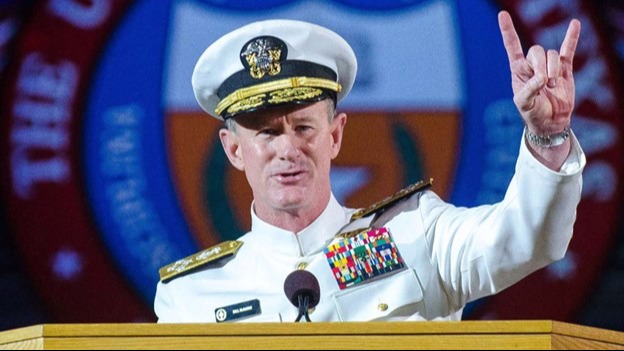

In our weekly blogs, we like to offer perspective—usually it’s about the markets, planning, or strategic decision-making. But sometimes, the best kind of insight has nothing to do with finances and everything to do with leadership, character, and resilience. This week, we turn to Admiral William McRaven’s viral 2014 commencement speech at the University of Texas.
Drawing from Navy SEAL training, McRaven offers a blueprint for how anyone can change the world. Not by doing one enormous act, but by embracing discomfort, leading by example, and refusing to quit. We encourage you to watch the full speech, but we’ve summarized the key takeaways and stories below. You can find the full video here.
Start by Changing the Lives of 10 People
Before jumping into the hard-earned lessons of SEAL training, McRaven offers a simple idea: if you can positively impact just 10 people in your life, and each of them does the same, the exponential effect could change the lives of billions. It’s a humbling reminder that you don’t need to lead a nation to be a world-changer. You just need to start with those around you.
Make Your Bed
Every day, training began the same way: with a bed inspection. It had to be flawless—corners tight, pillow just right, blanket smooth. Why? Because if you could start your day with one small win, it built momentum for the next, and the next. And even if the day was a disaster, you came home to something done right.
The takeaway? If you want to change the world, start by doing the little things well. The little things compound. The discipline and pride you build in the details will carry into everything else.
Paddle as a Team
One of the toughest exercises in SEAL training involves paddling inflatable boats through freezing surf. Each crew sprints with the boat over their heads, crashes into waves up to eight feet high, and has to paddle in perfect sync to stay upright. It’s brutal—and completely dependent on teamwork.
The crew with the shortest members, the “Munchkin crew”, was made up of men from different ethnic backgrounds. They were often mocked, underestimated, even laughed at. Nonetheless, they consistently outperformed the other teams.
If you want to change the world, let doubt fuel you, not stop you. Shared purpose always outpaces shared background.
Be a Sugar Cookie
Every day, the trainees were subject to a thorough uniform inspection. No matter how hard the trainees tried, their uniforms were never good enough. That meant getting punished. They were sent into the surf, told to roll in sand until every inch of their body was covered, then forced to stay that way all day. It was humiliating, cold, and frustrating. But the real test wasn’t about the uniform-even the most perfect presentation wasn’t sufficient. It was about how you responded when life was unfair.
If you want to change the world, you have to accept that life isn’t always fair—and keep moving forward anyway. Be willing to be a sugar cookie.
Don’t Fear the Circus
Trainees who didn’t meet the physical standards were assigned to “the circus”: an extra two hours of calisthenics at the end of a grueling day. It was meant to wear you down. But those who showed up to the circus day after day didn’t break, they got stronger.
The lesson is clear: failure is inevitable. But if you lean into it and accept it as part of the process, you’ll come out tougher, wiser, and better prepared. Don’t fear the circus. It may just forge the best version of yourself.
Slide Down Head First
One of the toughest obstacles in training was called the “slide for life.” After climbing a tower, trainees had to traverse a rope connected to a second, lower tower. Climbing hand-over-hand at a descending angle is incredibly difficult. One trainee, though, tried something different: he went down headfirst. It was risky, but it worked. He broke the course record which hadn’t budged for several years.
If you want to change the world, sometimes you have to accept the risk and take the leap to do it differently.
Don’t Back Down from the Sharks
During long open-water swims, SEAL candidates are briefed about the sharks. The message is blunt: if a shark circles you, don’t back down. Stand your ground. The trainees were told that if they were attacked, then punch the shark in the snout until it left you alone.
There will always be threats, but there is often wise to stand your ground. If you want to change the world, you can’t be passive in the face of adversity. Face it head-on.
Be Your Best in the Darkest Moments
During one of the toughest SEAL training exercises, trainees swim under a ship to simulate a combat dive. As they get closer to the hull, the light disappears. It’s cold, silent, and completely black. You can’t see your hands, your team, or where you’re going.
The whole point is to see how you perform when there’s nothing to guide you but your training and your focus. If you want to change the world, you must be your very best in the darkest of times. What you do in the dark matters most.
Sing When You’re Neck-Deep in Mud
During Hell Week, McRaven’s class spent a night buried up to their necks in freezing mud. Morale was at an all-time low when the instructors made an offer: if five men quit training, everyone else can leave. Out of nowhere, one loud, off-key voice cut through the night singing a shanty. One of the instructors told him to stop, but he kept singing and the rest of the class followed. What started as a single voice became something stronger than the mud, the cold, and the exhaustion. Every trainee made it through the night.
Hope is powerful. Even one person can change the energy of a room, a team, or a moment. If you want to change the world, be the voice that keeps others going.
Never Ring the Bell
At the heart of the training compound hung a brass bell. Any trainee could walk up at any time, ring it, and be done. No questions, no shame, just a quiet end to the challenge. But once that bell was rung, the journey was finished, and the chance to become a SEAL was gone for good.
There will always be an easy way out. But if you want to change the world, don’t ever ring the bell. Stay in the fight.
At DWM, we believe lasting legacies are built on thoughtful planning and intentional action. Strategy matters, but so do the small, consistent choices our clients make every day. Admiral McRaven’s message is a powerful reminder that real change doesn’t always start with grand gestures. It begins with discipline, follow-through, and the commitment to stay the course when it matters most.