


Kids cost a lot. As financial planners, we know the expected average cost that a child can be to a family. As a parent, I know that the actual figure can be much more than that average. In this blog, I will talk about one of the highest costs involved for many parents: college.
College is important. Take a look at the graph below. For those students who graduate college, they have that much higher earnings potential which typically leads to improved livelihood. A college degree typically pays for itself by age 30. Further, college graduates enjoy much better job security and job opportunity especially during economic downturns. Did you know that 70% of all jobs are held by workers that attended college? Further, college offers some significant social benefits including personal identity and confidence building.

But college isn’t cheap. College tuition costs have increased more quickly than just about any other household expense in recent decades with the average annual inflation rate at 5.6% over the last few decades. The cost of college typically rises because schools continually spend more money to attract the best students as well as hire more faculty and administrative staff, while receiving less and less financial support from the states. The reality is we don’t see college costs getting cheaper any time soon.
Take a look at the graph below to see where the average cost of public and private tuition is for a four-year program now for an 18-year-old versus what it could be for a newborn. Those figures could make any parent cry! The key is to start planning early. It’s also essential to be realistic about financial aid and making sure that savings earmarked for college are being invested.

By the way, less than 50% of students graduate in 4 years so keep that in mind. One way to really bring costs down is going the community college route, perhaps for the first couple years and then the college you really want for the balance. Staying close to home also allows the student to hold a part-time job where they can add to their education savings account for a few more years!
The good news is that close to 60% of families receive some type of grant (based on financial need) and/or scholarship (merit-based). Unfortunately, the dollar amount involved averages only about $5300 to $6600 per year. Hence, understanding what the cost of college is per the graph above, this barely makes a dent. In fact, only three out of 1000 college students, receive enough in grants and/or scholarships to cover their full cost – the so-called “Free Ride” is an extreme rarity these days. Regarding Federal financial aid eligibility, see the graph below for details. Unfortunately, many of the families that we work with won’t qualify.

As for athletic scholarships, don’t count on it. Only about 2% of high school athletes receive scholarships to play college sports and they usually only cover some costs. Sorry, but unless you have another Peyton Manning slinging the football around in your house, it’s probably not going to happen.
Many families wonder if a merit-based scholarship is in the making for their children. Scholarships are awarded for exceptional grades, exceptional test scores, exceptional athletics, etc. But as a parent that recently went through the college application process with two children, we know that the big name colleges are extremely competitive. Merit is really hard to come by unless that student is “perfect-perfect”, think 5.0 GPA and close to 1600 SAT / 36 ACT.
The good news is that if you’re willing to go to a school that’s not in the “top 50”, your chances of a merit-based scholarship improve dramatically, and you may be able to save literally hundreds of thousands of dollars. For my younger son, we settled upon Iowa State instead of some bigger name schools, thus saving our family potentially $100,000+ on the total cost of college!!! Let’s go, Cyclones!!!
Of course, there’s always the option of student debt, but it can be a major burden. Do you really want you or your child having that heavy weight on their shoulders right when they’re trying to launch their career and possibly start their own family?!? And don’t make the mistake of considering paying for college with your own retirement funds, jeopardizing your retirement security. That’s a big-time no-no!
By planning early, families can really make the process a feasible one versus one full of concern and anxiety. And one of the best ways to start is via a 529 college savings plan. These plans offer extremely nice benefits including:
- Tax-free investing and withdrawals for ‘qualified education expenses’.
- Account owner control for the life of the account.
- No income limits on contributions or age restrictions on beneficiaries.
- High contribution maximums (often $400,000 or more per beneficiary) depending on state.
- State income tax deductions on 529 contributions are possible in many states, including Illinois and South Carolina.
- For estate planning purposes, they allow contributors, e.g. a wealthy grandparent or other family friend, to “front-load” funding by putting in five years’ worth of gifts, thus a tax-free gift of up to $190,000, for the beneficiary in a single year!
- And a newer provision that gives you the option to make a tax-free rollover into a Roth IRA in the name of the beneficiary! Folks used to get concerned about overfunding a 529, but now you can roll up to $35K over. This can turn into an amazing retirement vehicle for your child! For example, a 25-year-old that receives this 529 money into a Roth in their name could turn that into close to a $400K portfolio by the time they retire!!!

NOTE: There are other different vehicles for college savings including custodial accounts like an UTMA/UGMA or a Coverdale Education Savings Account, but we generally see the 529 as the best fit for our family and clients. And as you can see below, 529 can be advantageous over other ways of funding like using your own Roth IRA or life insurance, home equity loan, or private loan.

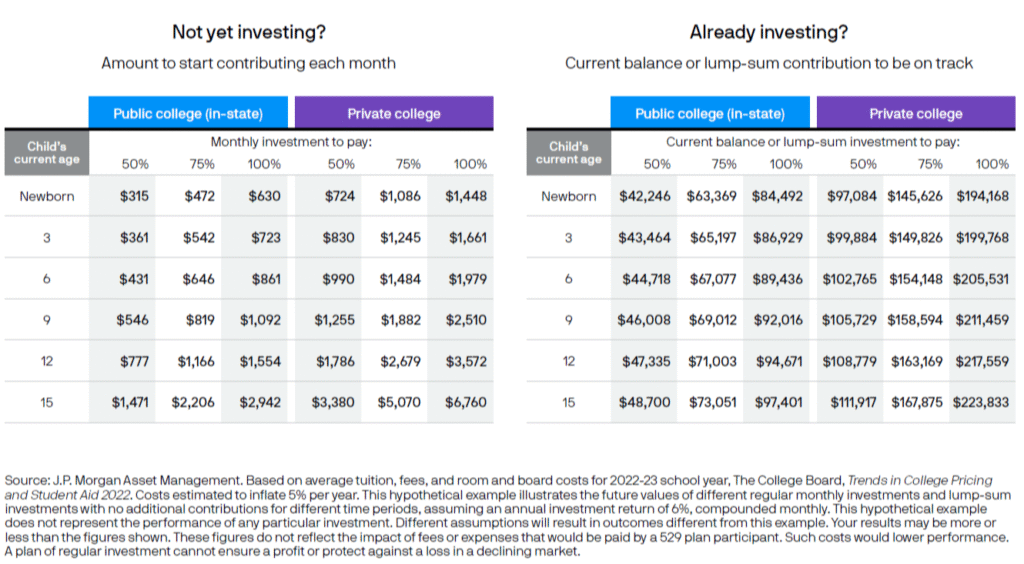
At the end of the day, it’s important to not just start saving early, but also to invest ASAP. With the inflation rate of college at 5.6% per annum, simply saving money in cash won’t get the job done. The sooner you start investing, the more time you have to grow your college fund via the power of long-term compounding. Get into gear and put your college investing on auto-pilot with regular automatic monthly or semi-monthly payments and watch it grow! Here’s a great chart below to show exactly how much monthly investment is needed to achieve a public or private college funding goal. One can clearly see the importance of starting as early as possible. Many young parents may not be able to put as much into the account as the table reads below, so take advantage of other cash “bumps” like: a job bonus, a family gift, or (given its TAX DAY today!!!) a tax refund! Don’t spend that extra cash on something nonsensical – pave your child’s college success by contributing now!
In conclusion, we hope this blog provides those couples thinking about having children / more children a better understanding of what goes on with college planning essentials. As a financial planner and family member who has personally gone through the process twice in the last several years, I can tell you that the most essential part is getting started as early as utterly possible. Truth be told, I had a 529 plan established with auto-contribution feature in place the week of both my boys’ birth. Never too early to start!