
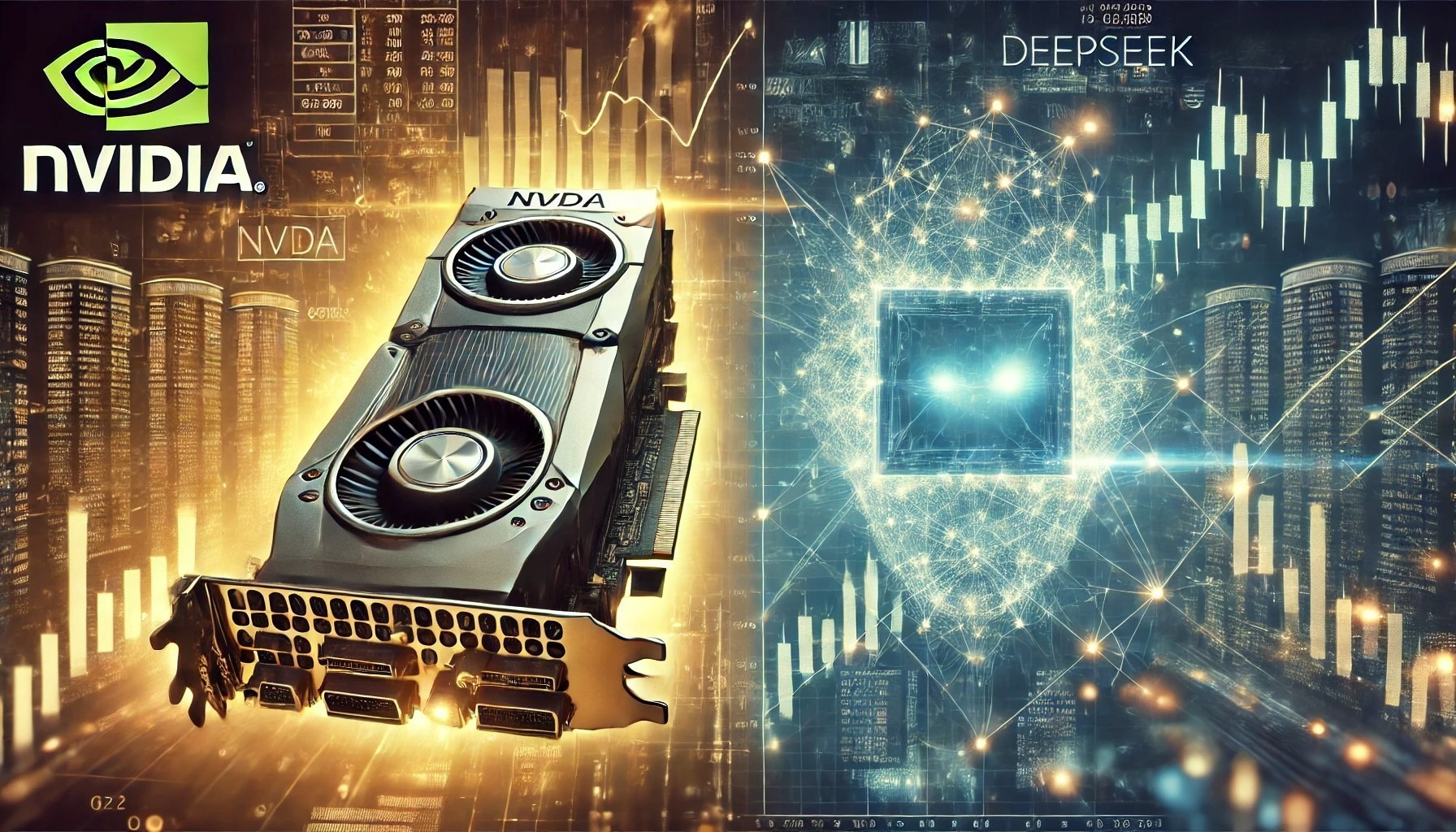

By now, we are sure you have heard about DeepSeek, the Chinese startup which introduced a cost-effective AI model in late January that spooked the global tech markets with Nvidia’s (NVDA) stock dropping 17% on January 27th. Not unexpectedly, NVDA’s stock has recovered most of that loss. But, the genie is out of the bottle.
NVDA has long been the cornerstone of AI hardware, powering OpenAI’s GPT and Google’s Bard. DeepSeek is a disruptor. DeepSeek’s cost-effective AI model requires fewer GPUs (graphics processing units) than NVDA and may reduce demand for NVDA’s GPUs, which are much more expensive. According to Dr. Deming Chen at the University of Illinois, DeepSeek achieves faster training cycles and lower energy consumption, which saves lots of money.
NVDA’s GPUs have some key advantages. They are engineered for parallel processing, making them ideal for complex AI computations. Their “scaling laws” use pre-training, post-training and test-time scaling to optimize model performance. And, their versatility supports diverse applications including data center and gaming PCs. However, while NVDA dominates the high-performance market, its much higher pricing excludes smaller players.
DeepSeek’s ability to deliver comparable performance on some of the applications at a fraction of the cost is its most compelling advantage. Think of the Gap, when in 1994 it created “Old Navy” as having a style similar to Gap but at much lower prices. DeepSeek is already making waves in the following sectors- media and content creation, academic research, and e-commerce and startups. Their low-cost model is making cutting-edge AI more accessible to a wider range of companies, developers and consumers.
It appears that NVDA and DeepSeek can work together rather than simply compete. DeepSeek still relies on NVDA’s hardware- though it uses cheaper versions, like H800 chips rather than H100 chips (2-5 times more expensive). NVDA has called DeepSeek’s R1 model “an excellent AI advancement.” This creates a potential coexistence where both companies cater to different market segments.
Going forward, DeepSeek, as a Chinese company, faces geopolitical hurdles that could stymie its global reach. And, scaling its operations while maintaining efficiency may be difficult. For NVDA, they must adapt to serve cost-sensitive markets and rethink its strategies around efficiency and affordability. DeepSeek is a small company and, in the long run, may not become a big player over time.
Even so, DeepSeek has brought a new paradigm to AI development-one that prioritizes efficiencies over brute computational power. While it challenges some of NVDA’s core markets, DeepSeek and others can collaborate with NVDA. Hopefully, as the AI industry evolves, this competition will hopefully drive further innovation and democratization of technology which helps all of us.
Conclusion: At DWM, we have welcomed the valuation growth of the Magnificent Seven including NVDA as it has helped produce very good investment returns to our clients’ and our portfolios. However, we have been alerting our clients for the last two years about the huge valuations that these seven companies have had, with prices far in excess of historical price/earnings ratios. Our investment philosophy for our clients and ourselves has always been to protect and grow. Diversification is key. Too much reliance on one or a few companies in your portfolio is not prudent.
We expect to see more “surprises” like DeepSeek in the future. Just yesterday, Microsoft announced that it has created a new state of matter to power quantum computers. This breakthrough is not solid, liquid or gas and could accelerate the development of everything from batteries to medicine to AI. The world is changing amazingly fast and we expect that acceleration to continue.
DeepSeek’s breakthrough has disrupted assumptions favoring hardware giants like NVDA. At the same time that the hardware ETFs were suffering sharp losses in late January, the software-focused ETFs outperformed. So far in 2025, large cap value stocks have outpaced the S&P 500 and international stocks have outpaced U.S. stocks. In the long run, it’s about fundamentals, diversification and staying invested.
These are exciting times. If you’d like to talk about your investments and/or your overall wealth management, give us a call or email. At DWM, we’re here to help educate and guide you!